

By now, we’re probably all familiar with most of the “big lies” about WWII. We know that Churchill was a drunken idiot, beholden to Jewish donors. We know that the Nazi’s did not bury, and then dig up and burn, one million bodies at Treblinka. We know that were no electric floors or furnace-rollercoasters at Auschwitz.
We’re also used to inversions in the WWII narrative. It was FDR who was looking for a war, but this is ascribed to Hitler. The Jewish Bolsheviks were the greatest mass-murderers of the 20th century, but this is also ascribed to Hitler. Stalin was hell-bent on conquering Europe and was on the verge of doing so, but again this is ascribed to Hitler.
While our media has labeled Hitler with many of these grandiose lies, it also enjoys labeling him with petty ones, so as to complete his comic-book villain reputation. After all, the most evil people aren’t just evil in grand ways, they also go out of their way to do evil whenever there is even a small opportunity for it.
One of the most notable of these stories has to be the claim that Hitler ordered the destruction of the Notre Dame cathedral and the Eiffel Tower upon the German retreat from Paris. As the story goes, this only failed to happen because the German commander at the time refused to follow the order.
This alleged story has been made into multiple movies, including Is Paris Burning? and Diplomacy. The story has so thoroughly penetrated the public consciousness that I imagine most are at least vaguely aware of it. In one of my favorite films, Before Sunset, Jesse relays the story to Céline, which probably reflects the vague awareness of the story among much of the American population.
In this scene, both characters express some uncertainty over whether the story is actually true or not.
It turns out that such skepticism is warranted, and that the story is a complete fabrication. A post from reddit’s “badhistory” subreddit provides a useful summary of the truth of the matter. Ironically, this post itself includes some “bad history,” but the basic facts of the case do seem to be solidly established.
First of all, we have one source for this story. It was the German commander, Dietrich von Choltitz, who claimed after the war that he disobeyed Hitler’s order and decided to save Notre Dame and the Eiffel Tower. Given that the reputation of Nazi commanders after the war could not possibly have been lower, and that their very lives were in danger, it seems quite obvious that von Choltitz’s story was extremely self-serving.
The post also relays how multiple historians have looked into the story, and found evidence directly contradicting it:
They only threatened "a few bridges at the most", according to historian Lionel Dardenne. Choltitz was most likely motivated only by his own treatment at the hands of the allies.
Historian Françoise Cros dug through mountains of archives to find evidence that bridges and landmarks were set up with explosives during Choltitz's short tenure as commander. Paris police archives show that the service des explosifs intervened in late august 1944 to remove explosives from several buildings. Her work with German military archives also show that Choltitz tried to bring in reinforcements until the very end. However, major landmarks such as the Eiffel tower were never threatened, it being rigged with explosives is pure invention. In an intervew with the Local, historian Lionel Dardenne, curator of the Museum of the Order of the Liberation, said: “He portrays himself as the saviour of the city, but the truth is he couldn’t have destroyed it.”.
In other words, we find that the Germans acted in a completely rational and normal fashion, which should be unsurprising. Explosives were found in places where they could actually confer a military advantage, such as by destroying bridges or other logistical hubs. Nothing was found under the Eiffel Tower or other major landmarks, because Hitler did not pop out of a Marvel movie.
While destroying a nearly millennium-old cathedral sounds cartoonishly evil, it turns out there is a kernel of truth in this whole story. However, the cathedral involved is not Notre Dame, it’s the lesser known but perhaps even more exceptional cathedral in Chartres.
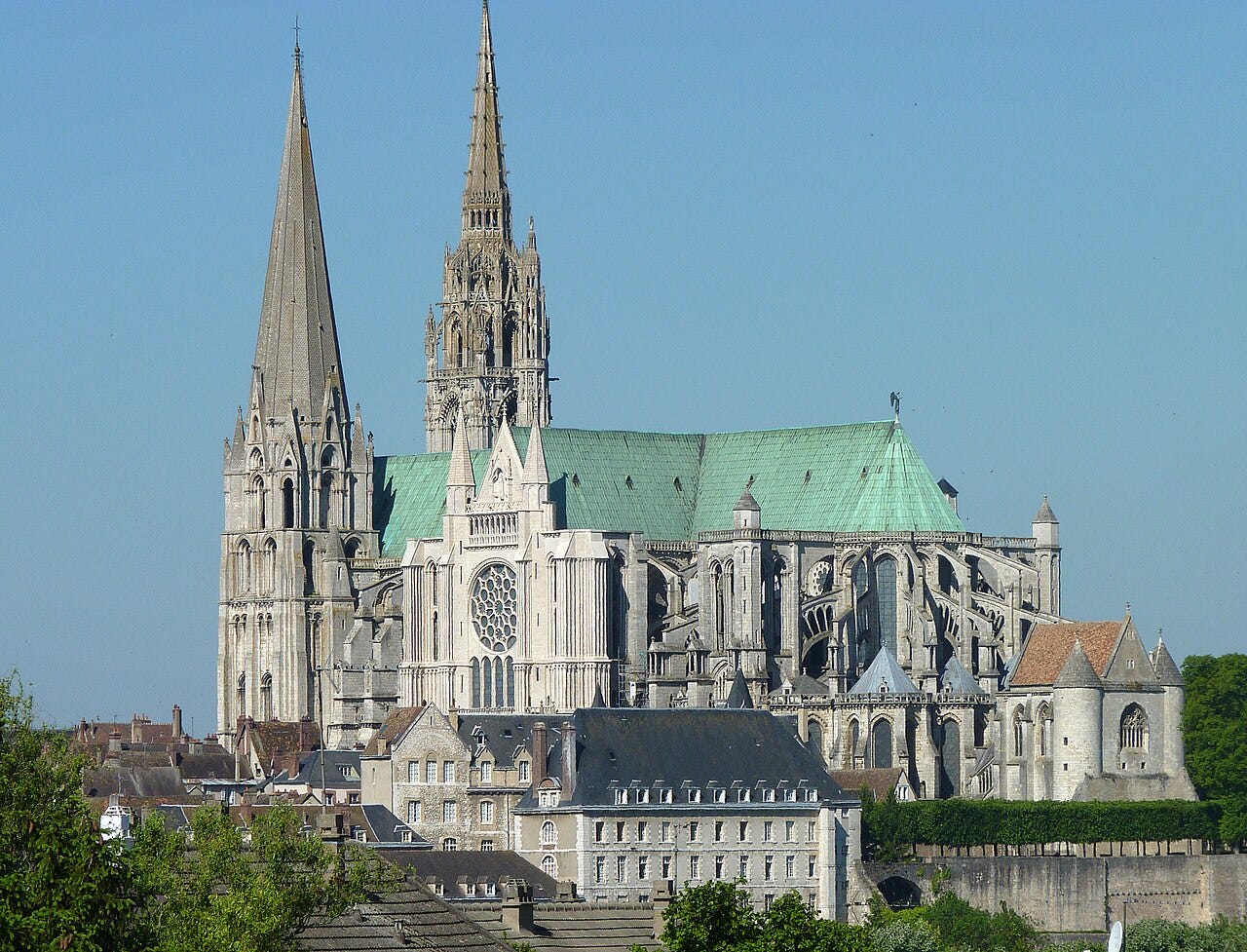
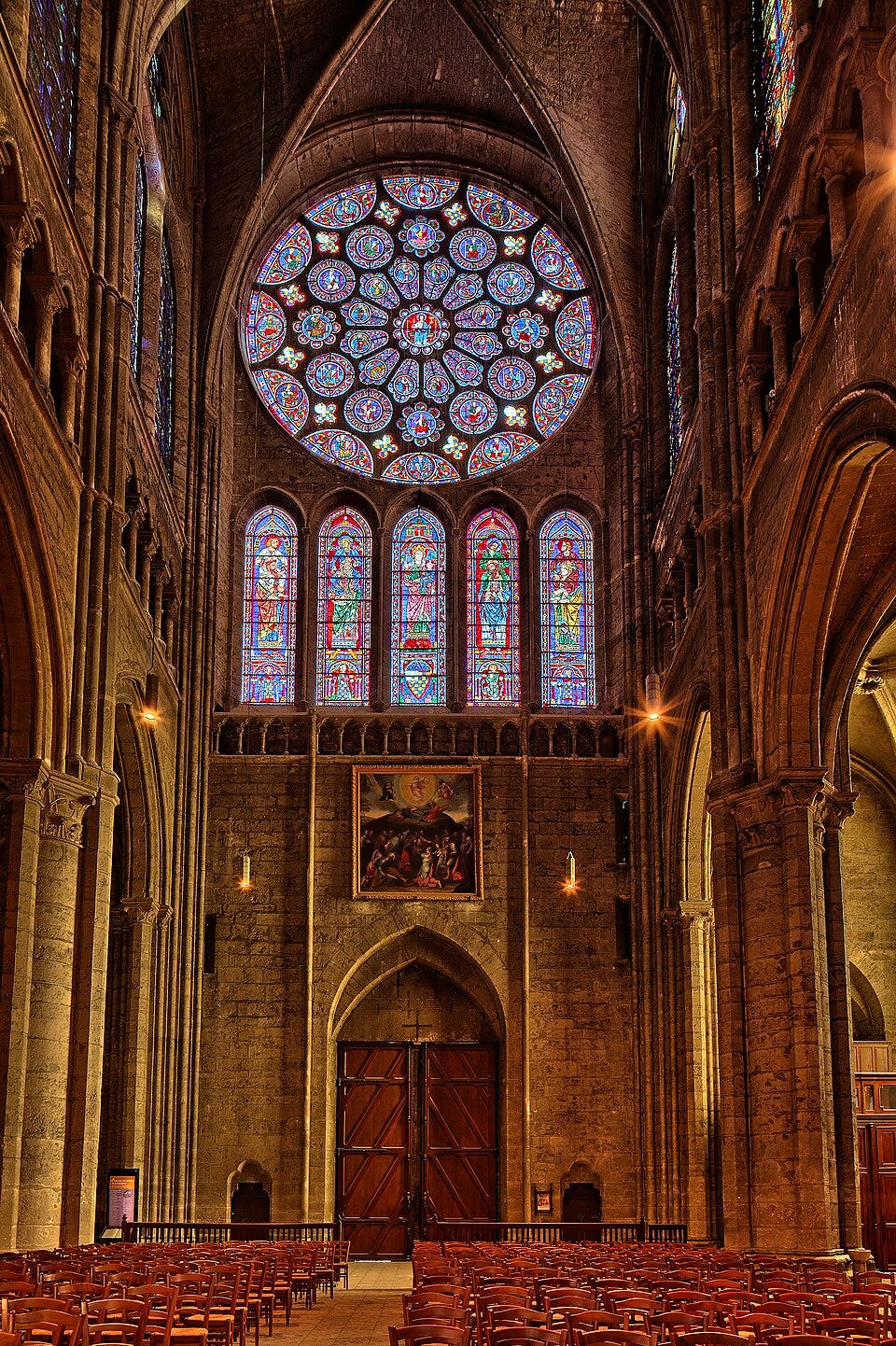
Renowned art critic Joris-Karl Huysmans wrote an entire book on the beauty and extensive symbolism of the Chartres Cathedral, entitled The Cathedral.
For Huysmans, Chartres may have been the greatest architectural achievement in the entire history of Western Civilization. The book includes many moving passages to describe the cathedral, but I will excerpt one of my personal favorites here:
In short, with her complexion of stone and her windows, Our Lady of Chartres was a blonde with blue eyes. She was personified as a kind of pale fairy, as a tall and slender virgin, with large blue eyes under her lids of translucent rose; she was the Mother of Christ from the north, the Christ of the Flemish Primitives, enthroned in a heaven of ultramarine and surrounded, as if by a moving recollection of the crusades, by these oriental carpets of glass.
And these diaphanous carpets were redolent of sandalwood and peppers, fragrant with the subtle spices of Magian kings; they were perfumed flowerbeds of hues picked, at the cost of so much blood, in the fields of Palestine, which the West that had gathered them was offering to the Madonna, under the cold sky of Chartres, in memory of the sunny lands where she had lived and where her Son had chosen to be born.
The Chartres Cathedral, like our civilization in many ways, was born in the crusades. I doubt that any other building in Europe is fused with so much spirit and fervor.
However, few people know how close we were to losing this masterwork. In the Second World War, a truly diabolical army was occupying France, and their command gave the order to annihilate the cathedral, with hardly a second thought. The only reason this order was not carried out was because one man defied his superior.
No, I’m not talking about the Wehrmacht here. I’m talking about the United States army. The Texas State Historical Association relays the actual story:
On the morning of August 16, 1944, Colonel Griffith, XX Corps commander Gen. Walton Walker, and other officers were informed about German machine gun and mortar emplacements occupying strategic spots in Chartres. During this briefing, Griffith learned that XX Corps Artillery had orders to destroy the medieval Chartres Cathedral.
…
After the staff meeting, Colonel Griffith decided to go to Chartres and determine if German forces occupied Chartres Cathedral. Along with his jeep driver, he entered the city and drove to the cathedral. Griffith witnessed a number of American soldiers firing at the cathedral but saw no return fire. He questioned the solders’ actions, but they contended German snipers were firing from the spires of the edifice. Unconvinced, the Texan walked into the cathedral and found no Germans in the various compartments. After inspecting both steeples, he climbed to the top of the bell tower, rang the bell, and hung an American flag from the belfry. After leaving the cathedral, Griffith sent an order to the artillery group not to destroy the cathedral.
Griffith then ordered his driver to head to the village of Lèves, a suburb of Chartres, on the main road to Paris. On this road, he encountered a German patrol of around fifteen men. After returning hostile fire from the Germans, Colonel Griffith ordered his driver to return to Chartres where he encountered a tank from the Seventh Armored Division. Griffith ordered the tank crew to proceed to the location where he engaged the Germans. He climbed on the back of the tank behind the turret and held a pistol in his left hand and a rifle in his right. As the tank moved through the streets of Lèves, it came under attack from machine gun, rifle, and rocket launcher fire. From the intense fire, Colonel Griffith was struck in the back and was killed instantly.
This story is further corroborated in the official record of Griffith’s Service Cross:
The President of the United States of America, authorized by Act of Congress July 9, 1948, takes pride in presenting the Distinguished Service Cross (Posthumously) to Colonel Welborn Barton Griffith, Jr. (ASN: 0-16194), United States Army, for extraordinary heroism in connection with military operations against an armed enemy while serving as Operations Officer (G-3) with Headquarters, XX Corps, in action against enemy forces on 16 August 1944 at Chartres and Lèves, France. On 16 August 1944, Colonel Griffith entered the city of Chartres, France, in order to check the actual locations and dispositions of units of the 7th Armored Division which was occupying the city. Upon observing fire being directed at the cathedral in the center of the city, with utter disregard for his own safety, Colonel Griffith, accompanied by an enlisted man, searched the cathedral and finding that there were no enemy troops within, signaled for cessation of fire. Continuing his inspection of outlying positions north of the city, he suddenly encountered about fifteen of the enemy. He fired several shots at them, then proceeded to the nearest outpost of our forces at which point a tank was located. Arming himself with an M-1 rifle and again with complete disregard for his own safety, Colonel Griffith climbed upon the tank directing it to the enemy forces he had located. During the advance of the tank he was exposed to intense enemy machine gun, rifle, and rocket-launcher fire and it was during this action, in the vicinity of Lèves, France, that he was killed.
General Orders: Headquarters, Third U.S. Army, General Orders No. 75 (October 21, 1944)Action Date: August 16, 1944
This article notes that “It is interesting that the commendation says nothing about his saving the cathedral from certain damage, if not destruction, by American artillery fire.”
Yes, this is interesting. The fact that an order was given to destroy the cathedral and Griffith defied this order is attested by Griffith’s secretary, Eugene Schultz, in The Ghost in General Patton’s Third Army: The Memoirs of Eugene G. Schultz During His Service in the United States Army in World War II.
After the order was given to level the cathedral, Schultz said that Griffith described his entering the city as a “personal mission.” It obviously makes little sense that a high-ranking officer like Griffith would have risked his life by going to the cathedral, behind enemy lines, unless he was trying to prevent the destruction of the cathedral. The government’s commendation conveniently omits this though, and portrays it as if Griffith was on official business, and that he just happened to see soldiers firing at the cathedral.
Ultimately, Griffith’s mission to save the cathedral cost him his life. There was obviously no spirit of the West in the American command, which callously ordered the cathedral destroyed, without even knowing if German soldiers were actually inside it. It is inspiring to know, however, that at least one man could feel the spirit of his heritage around that ancient monument.
We don’t know why Griffith made the decision that he did. There was little in his background to suggest an appreciation for art, architecture, or Catholicism. One article says: “We know that Griffith was from Quanah, Texas, and he graduated from West Point in 1925, where he played football. He had one daughter, who later shared the story of her father’s bravery. But none of the accounts of the story I came across explain why Griffith felt compelled to risk his life to save the cathedral.”
Perhaps Griffith was not working alone. Perhaps St. Louis IX worked through Griffith, to save the cathedral that he consecrated, built off the spoils of the crusader’s conquests for Christendom.
Today, Griffith is celebrated in the city of Chartres and its tourism brochures, but not much by his home country. No films have been made about his dramatic action, and his name doesn’t even seem to have appeared in any of our mainstream media.
Chartres still stands though. It stands because of the heroism of one insignificant man, who for unknown reasons, decided to do the right thing amidst the Jewish conquest of his ancestral homeland. The lesson from this story is unmistakable.
Great story. Curious who authorized the order and whether it was based on genuine intelligence.
That was a beautiful post