


I never saw La La Land when it first came out. It didn’t seem like a movie I would find appealing, and I had never been especially fond of musicals. Musicals at the time were represented by low-quality propaganda like Hamilton, and I was furious that Vice President Pence went to see Hamilton and allowed himself to be berated by the cast in the process. I probably mentally filed La La Land into a similar box, and I was only vaguely aware of it due to strange mishap at the Academy Awards, where the film appeared to win Best Picture but then the entire cast and crew were ordered off the stage and it turned out that a movie about black homosexuals had won instead.
Although I sympathized with those behind La La Land after that cringe-worthy incident, I still never made the effort to watch it. Occasionally though, I would see Nick Fuentes praise the film, and I always assumed this was just an example of his eccentricity. In one particularly emphatic recent clip, he castigated a hater of the movie, describing them as a gym-shorts wearing philistine who belonged at Buffalo Wild Wings.


This clip finally persuaded me to give it a chance, and I was very pleasantly surprised. I’d say it was probably the best film I’ve seen from the past ten or maybe even twenty years. Part of the reason it was so good is that it’s simultaneously lofty and idealistic, while also being realistic.
In La La Land, Damien Chazelle portrays what should be a storybook romance. Two dreamers, Sebastian and Mia, meet in the City of Angels and bond over their shared aspirations. At the same time though, they also struggle to balance their goals and their relationship. I thought that the authenticity of their relationship and its difficulties provided many insights into modern culture and society.
It would probably be inaccurate to call La La Land “right-wing art” though, as one of the commenters on that clip did.

Neither the actors, the characters they’re portraying, nor Chazelle himself seem to be especially politically active. If they have any strong political opinions, they probably lean liberal given their surroundings. If Sebastian and Mia were real, they probably would as well.
Isle Groyper is on to something though. In certain ways, La La Land does appear somewhat right-wing, but it’s probably not because anyone involved in its production was right-wing. It appears right-wing because the people who made it are genuine artists, and therefore have enough integrity to depict modern relationships as they are, rather than through the lens of low-effort wish fulfillment that is so often seen in Hollywood. When it comes to relationships, reality may just have a right-wing bias.
What this bias is though is not something that would generally be recognized as right-wing. Marriages among conservatives aren’t all that much less likely to fail than those among liberals, and it’s clear that modern conservatives suffer from many of the same problems that Sebastian and Mia do in La La Land. I suspect the reason for this is that Sebastian and Mia’s story reflects the consequences of the sexual revolution in many ways, and most modern conservatives have participated in that revolution as well. As with the struggle against interracial marriage and gay marriage, conservatives long ago waved the white flag in the battle over sexual morality.
La La Land is the story of Mia and Sebastian, but their story only covers a year or two of their lives. Most of Mia’s life will be spent with her unnamed husband, who is apparently completely unaware that he’s only participating in her epilogue. The ending of the movie, where Mia dreams of what her life could have been with Sebastian, shows that her husband has been emotionally cuckolded. It’s not difficult to imagine a scenario where he could also end up being literally cuckolded.
Obviously, the film isn’t about Mia’s relationship with her eventual husband. This isn’t a problem with the film, but it is a problem with our culture. One can only imagine how many married Mia’s there are in our country, where the movie of their lives stars a man entirely different from the one they’re married to. Does anyone imagine that would be conducive to marital stability?
Everyone was hoping that Mia and Sebastian would get married while watching the film. It’s clear at the end that Mia herself would have preferred this outcome, and it seems that her dream is an empty one without Sebastian in it. Chazelle chose to make the viewer feel this pain and think about it too, rather than gratifying our desires.
This is a tragic ending in many ways for Mia, who is fictional, but it’s also something that countless real people deal with as well. The fact that people form such strong bonds with those who are not their eventual spouse has led to many experiencing such bittersweet endings in their lives, frequently punctuated with a divorce. We should ask ourselves how this situation could have been prevented when we’re thinking about what kind of relationships our society should encourage.
Contrary to what some have said, Sebastian and Mia clearly did not love each other so much that they let each other go, so that the other person could fulfill their dreams. They had already split up before Mia was given her opportunity. Even after they reconcile, their relationship is still ambiguous. The point of the idealized clip show at the end is to illustrate that things needed to be different throughout their entire relationship.
The running tension throughout their relationship comes from the fact that the relationship is subordinate to their other priorities. When they have their fight about whether they will jointly leave for Boise or not, there is no expectation that they have to remain together. There’s the option of them both going to Boise and the option of them both staying in Los Angeles, but there’s also the tempting third option of separating. Since there’s an available exit door, their bond is fragile, and there is no necessity for them to compromise or find a solution.
What is the end result of this arrangement? A bond that should have been eternal is now severed because of temporary concerns. The bond remains imprinted on Mia and Sebastian forever, leading to regrets once the temporary concerns have passed. It also implants them with an invisible time bomb, ready to destroy any future relationship they may have, as they maintain a dual loyalty between their current spouse and the memory of their past love.
The best way to guarantee that this doesn’t happen is to ensure that the bond is either formed with no possible exit door or that it’s not formed at all. If the two people don’t feel strongly enough about each other to make a lifetime commitment, then nothing of value is lost from the bond being aborted, and they should refrain from sexual relations so that they don’t get anymore deeply involved with each other.
If they do feel strongly enough about each other to make a lifetime commitment, then they should get married and the legal and social consequences of divorce will help minimize the possibility of the bond being broken.
If Mia and Sebastian had been unable to have sexual relations before marriage, then they most likely would have gotten married, since they obviously felt very strongly for each other. If they had gotten married, then their relationship would have come first and they probably could have figured out a compromise with the Boise situation. This would have prevented the severing of a deep and beautiful relationship, and also protected Mia’s nameless husband from marrying into a trap.
In La La Land, Damien Chazelle depicts a romance that is sadly left at “it could have been.” Richard Linklater took a similar but somewhat different path though more than two decades earlier, examining the relationship that does stick. In Before Sunrise (1995), Linklater examines the epitome of a fairy-tale romance, and then revisits it 9 years later in Before Sunset, and then revisits it again after another 9 years in Before Midnight.


As with our protagonists in La La Land, Jesse and Céline in the Before trilogy bear the marks of their time. Jesse had come to Europe for the sake of meeting up with his girlfriend in Madrid, only to find out that she had developed some “friendships” with the local men. With his spirit broken, Jesse decides to ride Europe’s rails for a couple weeks to reflect and then to catch a cheap flight out of Vienna. Céline is also coming off a failed relationship, where she became obsessed with a deadbeat who broke up with her. Following this, she insinuated to her therapist that she may kill him. Céline leaves her native France to study in Vienna, and it’s on the train to Vienna that she meets Jesse.
Linklater is known for making films about disillusioned youth, and is thus skilled at capturing the feelings of the generation that was too young to live through the sexual revolution, but is living in a world where it’s normalized.
Céline’s parents were radicals, enthusiastic participants in France’s May ‘68 protests. According to Céline, they have a happy marriage and are supportive of her, perhaps overly so. In a form of measured rebellion, Céline puts on the appearance of a cynic, and doubts whether people can be happy with each other in the long term. She does retain her parents feminist views though.
However, as she opens up to Jesse, Céline remarks with a hint of bitterness that she sometimes has paranoid thoughts that feminism was invented by men so as to make it easier to use women sexually. Near the end of the film, Céline reveals that her cynical comments about lasting love are insincere, and that she really dreams of love and thinks that everything one does in life is a way to be loved more. She believes that she would love someone more the longer that she knew them, rather than less.
Jesse’s parents are divorced, although one gets the impression that they’re more conservative. Jesse’s mother revealed, in a fight with his father, that his father didn’t want him, and was angry when he learned she was pregnant. Because of this, Jesse believes that his life is wholly his own, and that he’s living even though he isn’t meant to be. Jesse frequently deploys lofty and romantic rhetoric about life, but candid moments tend to reveal that he’s the opposite of Céline, and is a cynic masquerading as a romantic. Jesse ridicules a street poet and a fortune teller as obvious charlatans, and he divulges near the end of the film that he has little interest in love, but instead wants to be known for excellence in something.
So, we have two people here, a man who has been pushed into cynicism by the divorce of his parents, and a woman who feels the need to mimic the rebelliousness and feminism of her parents, despite feeling natural opposition to it in many ways. Both of them have parents who have ill-equipped them for finding love, but they manage to do so anyway.
At the end of the film, they are on the verge of sleeping with each other, but Céline tells Jesse that she doesn’t want to because she knows she’ll never see him again. She says that if she sleeps with him, she’ll wonder who else he’s with and miss him, possibly forever. This passing thought is banished though, and she embraces him. The next morning, Jesse has to return to America and the two plan to meet at the same train station six months later.
After a 9 year hiatus, Linklater released a sequel, Before Sunset. It begins with the melancholy reveal that Jesse and Céline never reunited, because Céline felt it was more important to attend her grandmother’s funeral than to meet up when they had planned. Since they didn’t exchange contact information due to high-minded romanticism, they both disappeared into the void for each other, and have had a series of disappointing relationships with others since.
Céline’s feelings at the end of the first film have proven prescient, and she slowly reveals that she has not gotten over Jesse and vice-a-versa. In a moment of frustration, she reveals that she feels damaged and unable to fully recover every time a relationship of hers ends. She ends up missing even the most mundane things about a person after sleeping with them.
While it would be pleasing to think that Jesse and Céline have lost their ability to form other relationships because their own love is so transcendent, it’s unfortunately clear that the damage hasn’t been all in one direction. The other relationships that were formed and then broken have inflicted damage upon Jesse and Céline’s relationship as well. It’s obvious that Céline’s excuse of her grandmother’s funeral was not a satisfying one. It’s also obvious that Jesse feels that way, although he never says so explicitly, and it appears that Céline is aware of that as well. One is left wondering if there may be a deeper reason why Céline left Jesse alone at the train station.
In the third installment, Before Midnight, it becomes even clearer that there is disruption in their bond, and there are accusations of infidelity on both sides.
Without the broader societal context that we’ll discuss later in this article, it might seem confusing that such a lofty, almost metaphysically ideal love could suffer from such a lack of commitment in many ways. However, we may see Jesse and Céline as victims of a Cartesian-esque love, where soulmates attempt to bond without any regard for the extensive bodily damage that they’ve both incurred through the promiscuity of their time.
At one point in history, romantic love was hardly considered when forming marriages. It was believed that two people could be held together by biological necessity even if they never had an especially soulful bond. The version of marriage that is promoted today is almost the opposite, Cartesian in the sense that the people have been divorced from their bodies, and only the soul bond is considered important. If they’ve been in bed with one or ten or a hundred other people beforehand, we’re told it makes no difference since that’s a matter of the body and not the soul.
Of course, as Catholics we tend to favor Aristotle’s hylomorphic view of the unity of the body and the soul. The soul should not have to battle against biological damage like it does with Jesse and Céline, people are far better off if the soul can work in synthesis with the body.
For a parallel look on modern relationships, there is Atomised by Michel Houellebecq. If Linklater is portraying a world where soul bonds struggle against promiscuity, Houellebecq is portraying a world where promiscuity has smothered those bonds out altogether.


Houellebecq strips the veneer off of modern “dating” and portrays it as little more than a marketplace. The sexual market is a series of ruthless and frequently disgusting transactions.
On 14 December 1967 the government passed the Neuwirth Act on contraception at its first reading. Although not yet paid for by social security, the pill would now be freely available in pharmacies. It was this which offered a whole section of society access to the sexual revolution, which until then had been reserved for professionals, artists and senior management—and some small businessmen. It is interesting to note that the “sexual revolution” was sometimes portrayed as a communal utopia, whereas in fact it was simply another stage in the historical rise of individualism. As the lovely word “household” suggests, the couple and the family would be the last bastion of primitive communism in liberal society. The sexual revolution was to destroy these intermediary communities, the last to separate the individual from the market. The destruction continues to this day.
The story follows two brothers, whose mother abandoned them for a hippie commune. They represent two archetypes that have resulted from this new sexual paradigm. As with owning a small business, one better be ready to compete constantly to remain viable in the marketplace, the only other option is to leave the marketplace altogether. Bruno has chosen the former path, whereas Michel has chosen the latter. Today, we would probably recognize Bruno as psychologically similar to an incel and Michel as a volcel. Bruno is a single-mindedly obsessed sexual hedonist, although he frequently fails in his pursuits, whereas Michel has no interest in it at all.
Many found Atomised to be appalling when it was first released, both cynical and sickeningly graphic. What Atomised highlights though is the impossibility of melding love with transaction.
At one point in the story, Bruno finds what finally seems like love in his highly sexualized world. He meets a woman named Christiane and they seem to be forming a genuine relationship that Bruno has never had in the past. But she has an accident and becomes paralyzed from the waist down. He offers to have her move in with him but he hesitates when she asks if he’s sure. He doesn’t call her and she commits suicide a few days later.
Bruno and Christiane represent the extreme end of promiscuity, whereas Sebastian/Mia and Jesse/Céline are on the “normal” end. The ominous cloud that hangs over those latter relationships though is that they lie on the road to Bruno.
La La Land, the Before trilogy, and Atomised give us three different looks into the consequences of the sexual revolution. There’s the soulmates who can never be, the soulmates who are but struggle in spite of it, and there’s the people who may no longer even be capable of romantic love.
The Real Divorce Rate
To bolster our case that the sexual revolution has destroyed relationships, we should probably examine the most obvious marker of a failed relationship: divorce. Before we dive into this topic, it’s probably useful to know how many people are actually getting divorced. There’s been talk recently about how the divorce rate has been declining, and the official statistics bear that out. An article on this topic concludes that around 40% of today’s marriages will end in divorce. This isn’t great, but it’s better than the 50% that we saw in the 70’s and 80’s.
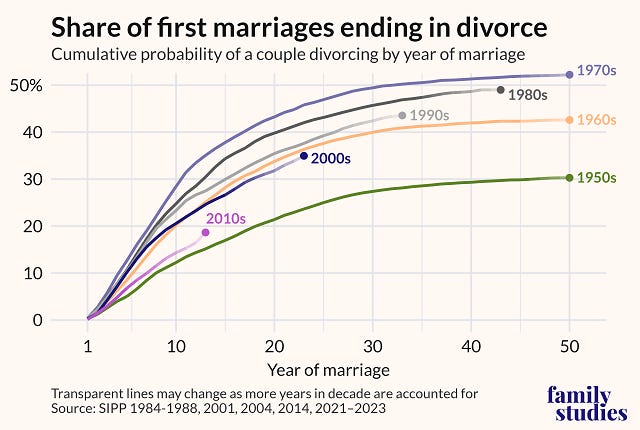
However, this is misleading. The reason why is because the number of people getting married has declined as well, especially among the lower income and lesser educated. So, there’s fewer marriages ending in divorce, but this is mainly because the people who are most likely to get divorced are now refraining from marriage altogether. The remaining marriage pool leans towards the middle/upper classes who are more stable.
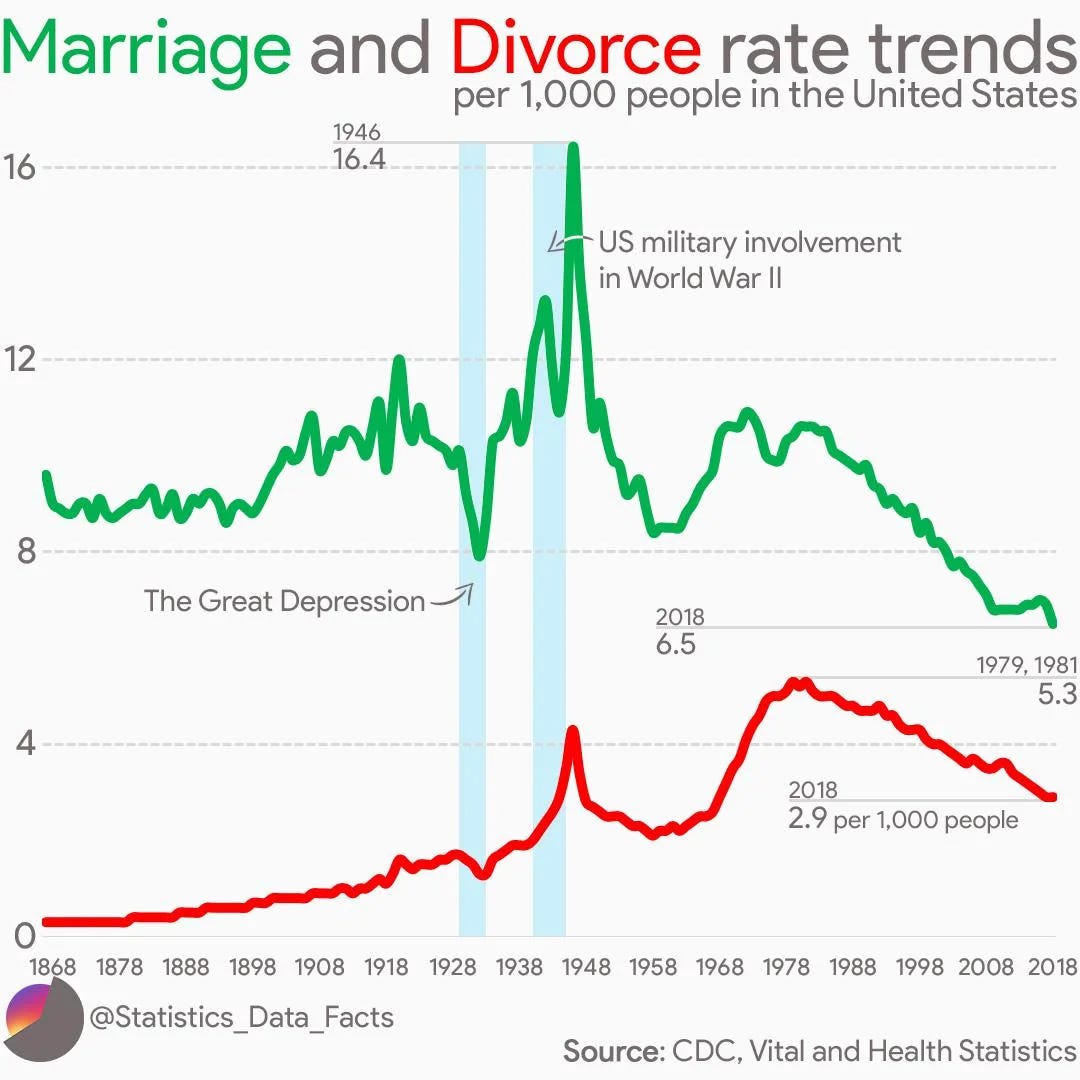
Detailed by year: https://www.infoplease.com/us/family-statistics/marriages-and-divorces-1900-2012
https://www.cdc.gov/nchs/data/dvs/marriage-divorce/national-marriage-divorce-rates-00-23.pdf
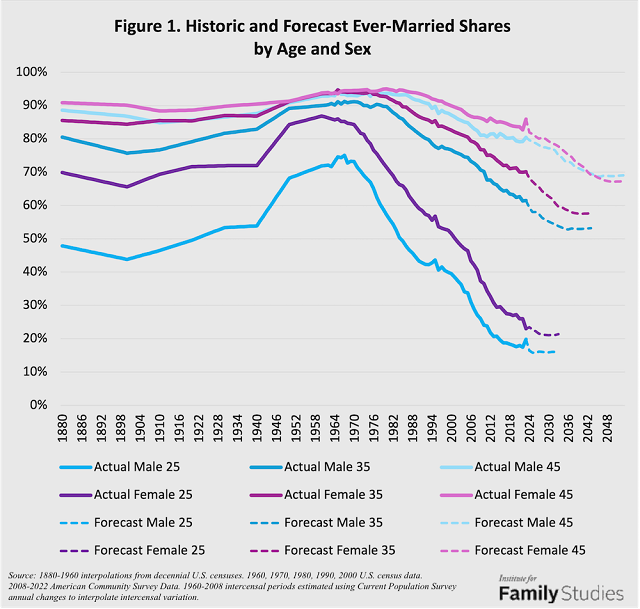
A whopping 32% of 45-year old women and 42% of 35-year old women are now projected to have never been married by 2045. Once we factor in this enormous increase in women remaining unmarried throughout their child-bearing years, it’s quite likely that the portion of those who are in unstable unions has actually increased since the 70’s and 80’s.
Let’s use this information to try to craft an adjusted divorce rate, that gives us the percentage of women who end up without a lifelong partner.
The best way to account for the rise in unmarried women is by adding the percent of women who will remain unmarried at 40 to the percent of women getting divorced. To do so, I took the middle of the percentage of women who were still unmarried at 35 and 45 for a particular year and added that in for the year that they were 25. For example, 19% of 40 year old women were never married in 1995, and I added that to the divorce percentage for 1970.
The reason I did this is because 25 is a good age to approximate when a woman is making major life decisions, and therefore we can see how the environment of that time might have impacted whether she ended up married or not by 40.
For the remaining portion of women who did get married, I multiplied this by the divorce rate for that year and then added the result to the unmarried percentage that was already calculated. In total, this will give us a rough idea of what portion of young women at a given time ended up divorced or remained unmarried.
With that adjustment, here is the result:
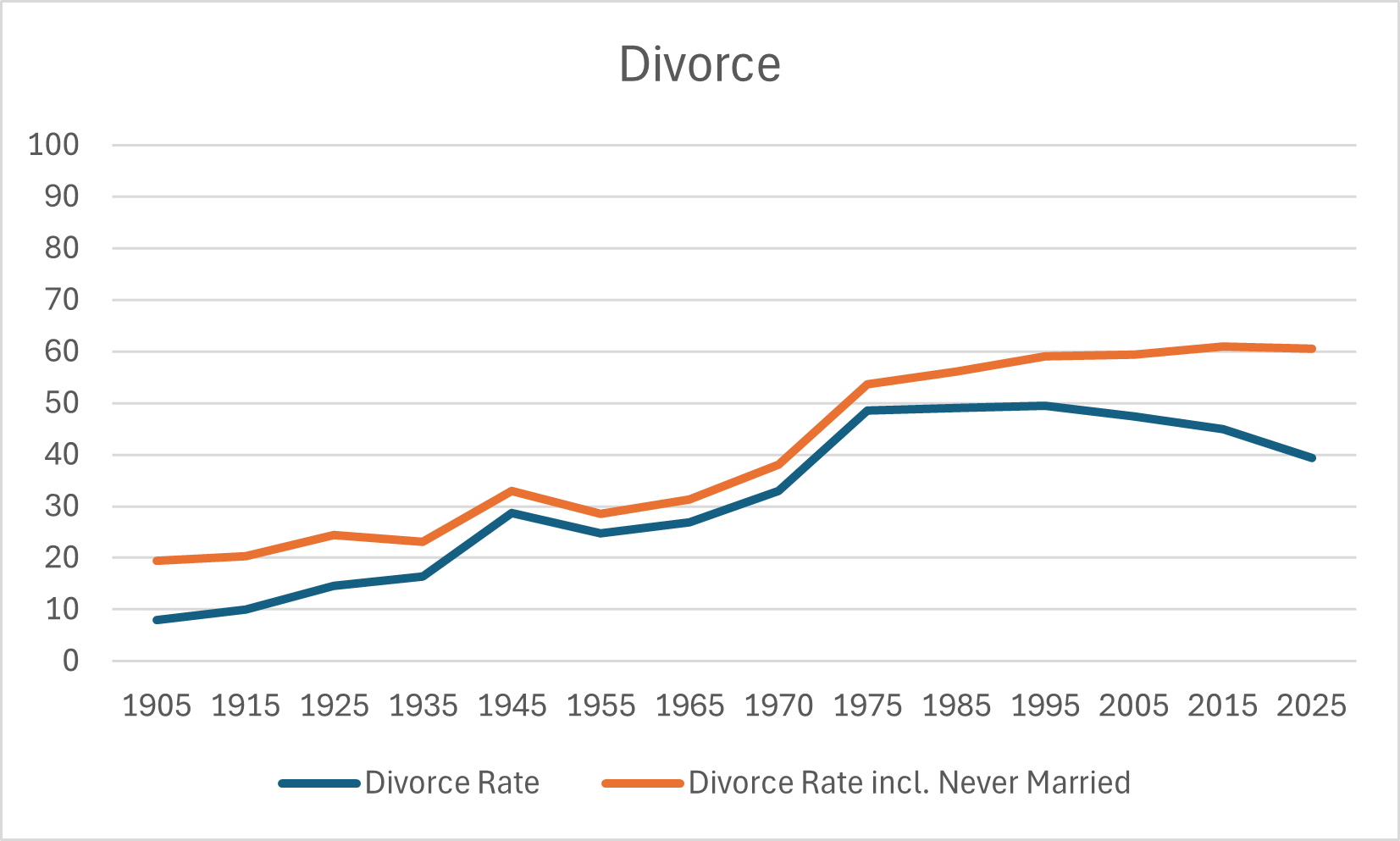
As you can see, while there has been a substantial decline in the crude divorce rate, this effect vanishes after factoring in those who never marry. We in fact see that the adjusted rate is near a record high, having increased from around 55% in 1985 to around 60% by 2025.
In other words, a 25 year old woman looking for a lifelong spouse in 1910 was almost certain to find one. In 2025, she most likely will end up either divorced or unmarried.
The Cause of Rising Divorce
While the enormous rise in the divorce rate over the 20th century is universally acknowledged, the conventional narrative is that this doesn’t actually reflect any weakening in marital unions. What we are told instead is that many people in the past would have wanted to get divorced, but were unable to because of legal restrictions.
This legalistic argument doesn’t hold much water. It’s true that the passage of no-fault divorce laws in the 1970’s coincided with a major spike in the divorce rate, but as you can see from the graphs, divorce had been steadily increasing for nearly a century before 1970. The divorce rate had already more than quadrupled from 8% in 1900 to 33% before the beginning of the 70’s. Even though divorce cases in this time technically needed to prove “fault,” there were many ways for people to get around this.
Therefore, it’s very likely that the increase in the divorce rate does reflect a genuine weakening in marital unions. The 20th century was a time of upheaval, and there could have been many potential influences that drove the weakening. One of the most well known changes in relationships during this time though was the sexual revolution. As with divorce, premarital sex also gradually increased throughout the first half of the century, and then spiked shortly before a spike in the divorce rate followed.
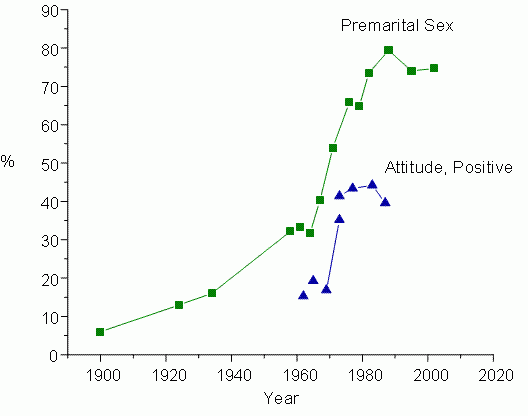
As you can see, it was the upswing in premarital sex during the 60’s that preceded the plummeting marriage rates and surge in divorce that happened throughout the 70’s.
This measure of premarital sex may not be entirely perfect. It only measures whether a woman had premarital sex up until 19, and therefore the real number would be higher to account for those who did not have premarital sex until after 19, and this would greatly increase the percentage for later decades as the average marital age increased. Along with that, it also doesn’t capture the percent of women who had premarital sex, but only with their eventual spouse. Research shows that this is effectively the same as not having premarital sex at all. This would lower the number.
Let’s see if we can figure out the numbers for how many people had a nonspousal partner before marriage. To help with the aforementioned issues with Chart 5, Chart 6 shows us how many premarital partners women had for the decade that they were married in.
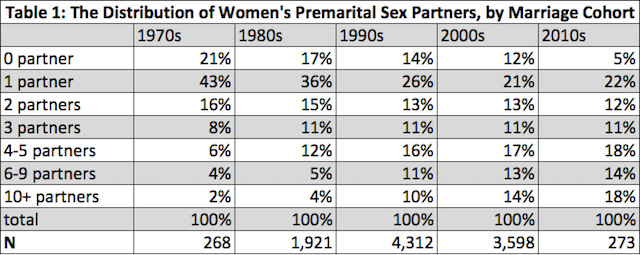
In this data, “1 partner” is presumed to be the woman’s eventual spouse.
This data helps us with 1975 onward, but it doesn’t go back as far as the first chart. However, the 1970’s had a similar marital age to earlier in the century, and half of the premarital sex in the 1970’s was only with the woman’s eventual spouse. We can presume that this ratio was similar before. Therefore, for the years before 1970, I divided the premarital rate in two to get an approximation for how many women had a nonspousal partner.
We should also factor in the nonspousal rates for men too, since research indicates that it predicts divorce for men the same as women. This is a little more difficult since we have less data, but we do know that around 27% of married men born before 1900 had a nonspousal partner and that this rose to 78% by the late 60’s. We can fill in the rest of the male numbers with approximations based on the trends for women.
Along with that, we should account for the fact that Chart 6 only looks at married women and doesn’t factor in women who never married. These will be counted as having had a nonspousal partner, given that’s it’s very rare for people to remain celibate past their 20’s. We will count these in the same way for the male data.
All together, I graphed this data to compare the trends in having had a nonspousal partner alongside the adjusted divorce rate.1
This methodology might not be perfect, but the general trend is unmistakable. A gradual increase throughout the first half of the 20th century, an enormous surge beginning in the early 60’s, and a leveling out later in the century. This ends up looking quite similar to our divorce chart, and graphing them together shows that:
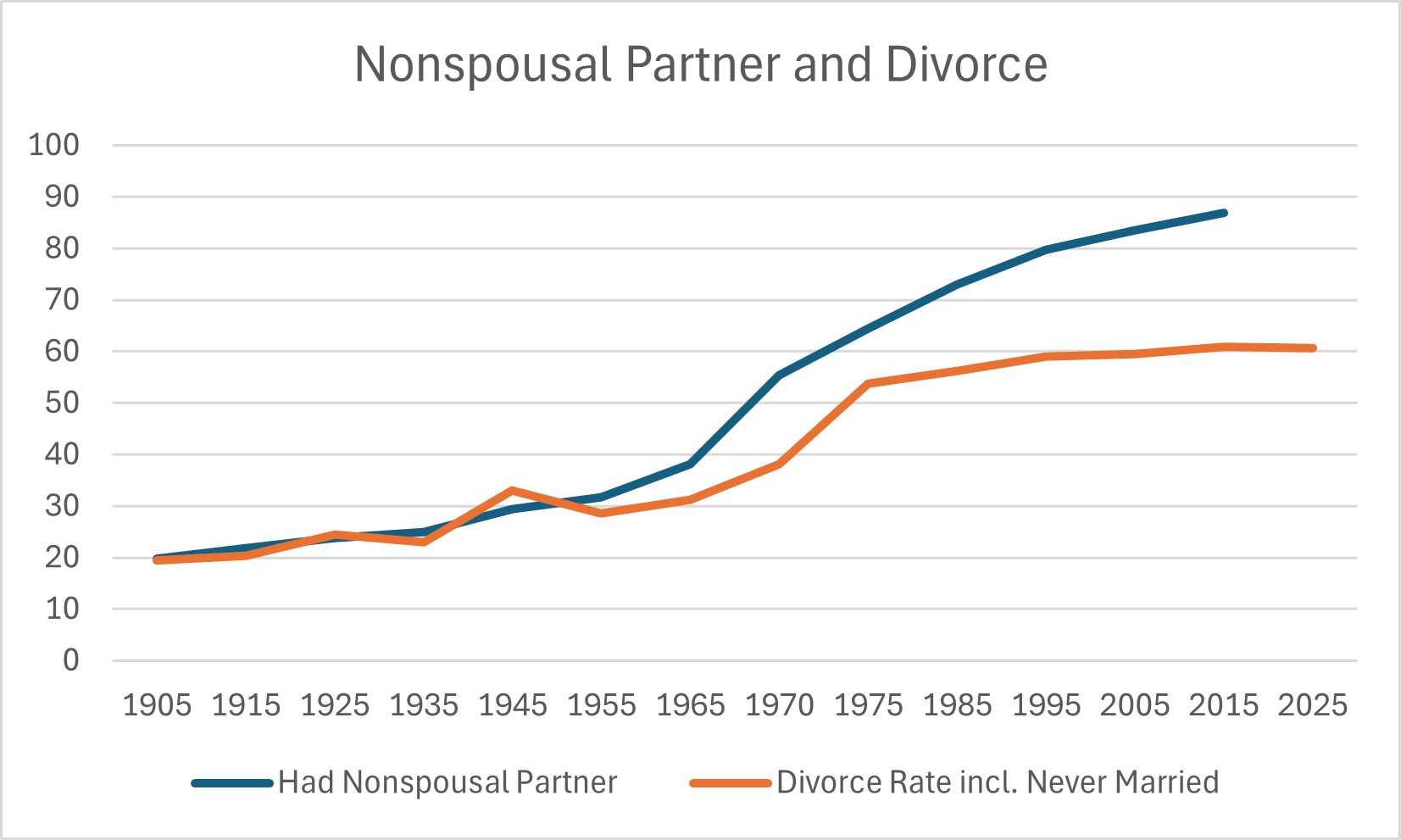
It is true though that the rise in divorce after the 70’s is more muted than the rise in nonspousal partners. Most of the latter rise is a reflection of people marrying later, rather than a general increase in promiscuity. Older marriages tend to have lower divorce rates than younger ones, so it’s possible that this tailwind counteracted the headwind of having had a nonspousal partner.
It’s also possible that the damaging effect of nonspousal partners is reduced if spread out over a longer period of time. Someone who sleeps with three people at 19 and then gets married at 20 is probably going to be more damaged than someone who has slept with three people over ten years and then gets married at 28.
Another possibility is that there’s simply a ceiling on societal instability. Perhaps a portion of the population is stable enough, for genetic reasons or otherwise, that they can form stable unions regardless of the damage they’ve incurred.
Regardless though, the correlation is still clearly very significant. Obviously, not everyone who has sexual relations with more than one person is bound to end up divorced or unmarried. But if that were the case, the statistics wouldn’t look much different from what they actually are. This raises uncomfortable questions about whether many marriages are doomed before they even start.
A reasonable question though is whether what we’re seeing here is actually a result of causation or is just a coincidental correlation. Perhaps some hidden factor led to both a rise in promiscuity and a rise in divorce, without the promiscuity causing the divorces.
Various academics have asked exactly that question when examining the correlation between premarital sex and divorce. Prof. Jay Teachman conducted a study that accounted for many variables such as age, education, childhood conditions, race, religion, etc. He found that none of these factors could explain the correlation between having had a nonspousal partner and divorce. Having a nonspousal partner still more than doubled the odds of divorce.
A 2024 study from Prof. Nicholas Wolfinger examined a different data set, accounted for more variables, and came to the same conclusion:
Previous research pointed to a variety of individual and social variables to explain the relationship between premarital sex and divorce, including nontraditional views on sex and marriage, weaker religious attachments, and lower-quality family relationships (Kahn & London, 1991; Paik, 2011). We find no support for these explanations, and show that the effect of premarital sex remains highly significant after accounting for a wide range of individual and social differences between respondents.
The connection that Wolfinger found was even stronger. Having had a nonspousal partner nearly tripled the odds of eventual divorce. Interestingly, Wolfinger also found that the effect increased as more partners were added. Those with 1-8 nonspousal partners had a 64% higher chance of divorce, but those with 9+ had a massive 220% higher chance of divorce.
Wolfinger states:
Taken together, these results suggest that the relationship between number of premarital partners and marital dissolution is nonlinear. They point rather to three tiers of divorce risk, with the lowest risk for those with no premarital, nonspousal partners, a modest increase for those with some, and a sharp increase for those with many. These results are more consistent with the notion that the effect of premarital sex on divorce becomes stronger, not weaker, as sexual partners accumulate.
The impact of casual sex therefore resembles many other addictions. Some of those who drink or smoke can do so in moderation, damaging their health but in a way that doesn’t become catastrophic. For those who lose control though, they can fall off an abyss that may be almost impossible to climb out of.
How Promiscuity Creates Divorce
Existing research strongly points to a causal link between promiscuity and divorce by ruling out other explanations for the correlation. However, little research has been done on the mechanics of how promiscuity causes divorce. Wolfinger mentions some of the existing theories:
Alternatively, the experience of premarital sex itself, especially with multiple partners, may contribute to the development of more permissive attitudes toward sex or a greater awareness of sexual alternatives, either of which may serve to undermine marital stability (Paik, 2011; Teachman, 2003).
Either of these explanations may have merit, but since the effect of promiscuity resembles an out of control addiction, I think it would be valuable to examine how other addictions do their damage.
A classic example is that of hard drugs, such as cocaine and methamphetamine. It has long been known that drug addicts tend to have a crash after their drug expires, and then require a stronger dose the next time to get the same result. A recent study examined how this is because their dopamine receptors become gradually desensitized due to repeated overexposure.
Dopamine receptor desensitization occurs after repeated exposure to high dopamine levels. Receptors become less responsive to dopamine, requiring higher drug doses to produce the same effects. In response to desensitization, receptors like D2 are internalized, making signaling more difficult because fewer receptors remain on the plasma membrane [51, 52]. Consequently, D2 receptor function is inhibited, further impairing their autoreceptor activity.
While dopamine creates a feeling of pleasure, it’s oxytocin that enables pair-bonding. Oxytocin is released during sexual intercourse, childbirth, and breastfeeding. Biologically, this makes sense. One wants to bond with their child or someone who they may have a child with.
While this is well known, it’s less well known what the effect is of breaking one of these bonds, and how it may affect ones ability to form a new one. However, a study of Prairie voles was conducted to examine the brain chemistry behind depression after the loss of a loved one. Prairie voles were considered to be good test subjects since they are also monogamous and use oxytocin to pair-bond.
What the study found was that separation from a partner led to a crash in oxytocin that was difficult to recover from:
Finally, loss of a partner can be one of the most devastating experiences of a person’s lifetime and is associated with increased depression (Biondi and Picardi 1996; Watanabe et al. 2004; Zisook et al. 1994, 1997; Assareh et al. 2015). Prairie voles have been the first model organisms to provide insights into the neural mechanism associated with psychiatric phenotypes based on the loss of a partner. Our research has shown that partner loss increases CRF signaling in the brain, which leads to an impoverished oxytocin environment especially in the NAc; OTR in the NAc are reduced, as is the excitatory drive onto oxytocin neurons. Each of these processes reduces oxytocin tone, leading to an aversive state and eventually to passive coping behaviors reminiscent of bereavement. This system may play an adaptive role in the wild by serving to maintain pair bonds over a lifetime, but become maladaptive if reunion with the partner is not achievable.
Given that sexual intercourse creates an oxytocin glued pair-bond and that losing that bond probably creates an oxytocin crash, it should be unsurprising that “hookups” cause significant damage to mental health:
In addition to sexual regret, casual sex is associated with psychological distress, including anxiety and depression, as well as low self-esteem and reduced life satisfaction (Bersamin et al., 2014). Research specifically examining hooking up suggests that having engaged in a hookup (Fielder, Walsh, Carey, & Carey, 2014) and number of hookup partners (Grello, Welsh, & Harper, 2006) are related to greater symptoms of depression.
The question then is whether oxytocin receptors can be desensitized in the same way that dopamine receptors can. If a pair-bond is broken, will oxytocin production be inhibited the next time that pair bonding is attempted? Can these receptors be “fried” in the event that a large number of pair-bonds are formed and then broken?
More research into Prairie Voles suggests that the answer to both of these questions is likely, yes. In the wild, it is very rare for Prairie Voles to form a new pair-bond after the first one is broken, with less than 20% doing so. A study was conducted to see if this was an effect of having pair bonded in the past or for some other reason, such as a lack of available mates. The study concluded:
The results confirm field observations that availability of males is not a factor in the failure of female prairie voles to form a new pair following loss of their mate. This study concludes failure to form a new pair is associated with pair-bonding behavior.
It was especially obvious that a lack of males wasn’t the problem, because most of the widowed Prairie Voles continued to be sexually active, they just weren’t bonding with their new partners.
Those single females that do not acquire a new mate remain reproductive. They copulate with wandering males that do not move in with the female or share her home range.
This may be sounding familiar. In human society, a female engaging in this sort of behavior would historically be referred to as a whore. Once the female Prairie Vole loses her first pair-bond, her ability to form a new one appears significantly degraded and she essentially spends the rest of her life whoring.
The study doesn’t examine if this is related to a change in neurochemistry, but it’s obvious that Prairie Voles would not differ in abstract human values such as “attitudes towards sex” or “awareness of alternatives.” Since it’s the oxytocin that drives the Prairie Vole bonding in the first place, it seems very likely that its production is inhibited when they have intercourse with a new partner, explaining why they rarely form new bonds.
Of course, this all mirrors what we see in human beings, where the data shows that we struggle to form lasting bonds after having broken our first one. It shouldn’t be surprising that this problem grows worse the more times this is done, resembling a drug addiction. Given that oxytocin is frequently called the “love hormone,” it’s in the realm of possibility that those who are promiscuous could become biologically incapable of love. Various internet browsers have frequently pointed out that the promiscuous tend to get a glazed over look that resembles a “thousand yard stare.”


Whether these people could be rehabilitated, like a drug addict, is an open question.
A Grand Bargain with Feminists
Now we can feel relatively confident that having nonspousal partners is a primary cause of divorce, possibly the leading cause. The question is though, how do we stop it?
Christian conservatives have undertaken efforts for years to promote abstinence-only sexual education in schools so as to reduce premarital sex. These efforts have proven to be a dismal failure though, both ineffective and subject to general ridicule.
I suspect the primary reason for this is because these groups are generally hesitant to focus on the marriage-destroying impact of premarital sex, most likely because this would be seen as an attack on the married parents of many of their students. If little Billy were to come home and say “Mr. Smith told me that your marriage is doomed to fail!” then Mr. Smith would soon find himself in some hot water.
So, right-wing Christians have generally limited their focus to the fact that abstinence is the only guaranteed way to avoid STD’s and teen pregnancy.
The only problem with this argument is that common forms of contraception can reduce the risk of both of these things to near-zero. Liberal parents can therefore counter with saying that schools shouldn’t pretend that teenagers won’t have sex, and should instead just teach “safe-sex,” using these forms of contraception.
Christians have essentially no rebuttal to this, and so are usually forced to resort to a purely moral/religious argument against premarital sex. This is naturally unpersuasive to the vast majority of Americans who are unfortunately non-religious or lax in their religion. On top of that, this religious argument is frequently packaged with an insistence on teaching Young Earth Creationism, creating the perception that opponents of premarital sex are just motivated by blind dogmatism.
Let’s say we were to educate teenagers about the dangers to their future relationships coming from premarital sex. Would such a campaign actually be able to reduce such an alluring and addictive behavior?
History says it would. One example is the extremely effective campaign against smoking. At one point, roughly 50% of Americans smoked cigarettes. That number has now dwindled to around 10%, despite the highly addictive properties of nicotine. The effectiveness of this campaign can probably be credited to the coordinated, multi-step effort that originated from the highest levels of the federal government. A useful chart shows the various events along the way.
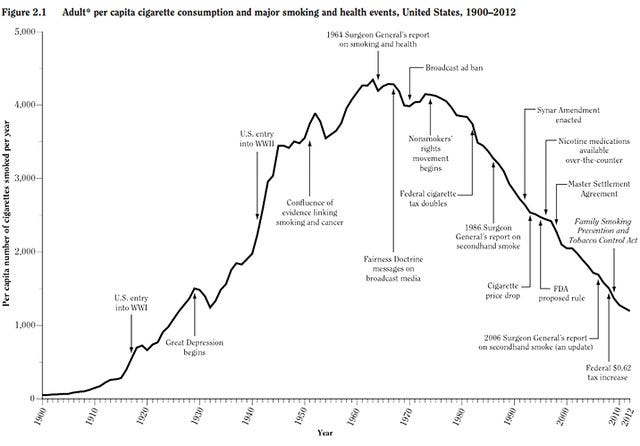
It appears that this was a multi-step process, roughly laid out below.
Surgeon General reports the damaging effects of smoking, beginning a government led-effort against smoking.
Advertisements for smoking are banned.
Cigarette tax doubled.
Tobacco banned nationwide for under-18’s.
Tobacco companies sued for tobacco related healthcare expenses.
Given this history, I would propose a similar campaign to reduce premarital sex, something along these lines:
Step 1: Use the Department of Education to implement mandatory, nationwide reform to sexual education programs, focused on the content discussed in this article.
Step 2: Ban positive depictions of premarital sex in the media. Return to the Hays Code, and apply it to social media and the internet as well.
Step 3: Raise the cost of contraception. This is especially important. See the chart below:
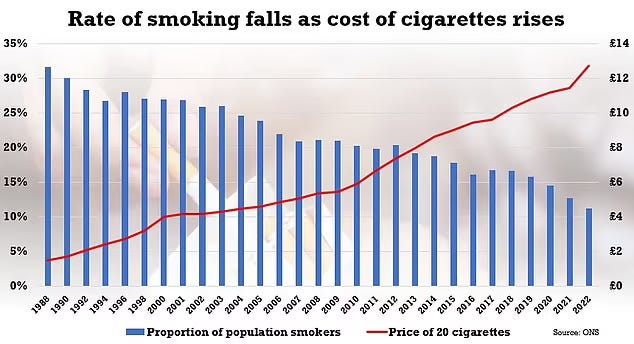
As of right now, contraception is frequently covered by insurers. Without insurance, contraception would cost between $600-800 per year, about half what it now costs to smoke for a year.
Banning insurers from covering contraception for the unmarried would be the first action. Then, the taxes should be increased to the extent that it drives the cost of contraception at least to that of smoking.
Finally, those getting divorced should be allowed to sue contraception manufacturers to recover their legal fees. These companies would be forced to raise prices to cover the cost of the payouts. This would have the extra benefit of linking divorce with premarital sex in the public consciousness.
Step 4: A rolling-age ban on contraception. Start with banning it for those under 21, then increase it to 22 the next year, then 23 etc. New Zealand recently implemented this for smoking.
This would all be a good start, but there is one potential problem. That would be the inevitable backlash from unmarried women and feminist organizations that would result from restricting contraception. To some extent, they may have a fair point. If unmarried people have sexual relations and it results in a pregnancy, the burden of that will disproportionately fall on the woman. Although she can sue for child support, the father is frequently impoverished and therefore around 30% of the mothers are paid nothing and 54% do not get the full amount.
Questions of fairness aside, it is also very important to deter men since men are usually the initiator of relationships. In the past, if an unmarried man and woman engaged in sexual relations, the woman’s father or brother would sometimes try to kill the man. Obviously that’s not viable anymore, but we do need a similarly strong deterrent for men. Fortunately, the basis of that may already exist.
Feminists advocates have been notorious in recent years for targeting men engaged in normal sexual relations. Frequently, a woman will have casual sex with a man, regret it after, and then accuse the man of raping her. Given the natural ambiguity of premarital relations and the power of Title IX, these cases are frequently won by the woman, resulting in the total destruction of the man’s life.
In response to outraged men, feminists have said that men can avoid this danger by obtaining “affirmative consent.” In other words, the man must obtain consent from the woman that is so crystal-clear that there is no doubt whatsoever as to her consent. In practice, this would probably need to be in writing.
This onerous and bizarre regime has scared many men away from engaging in casual sex at all. However, if these strange requirements are looked at from a birds-eye view, feminists have inadvertently been pushing to rebuild traditional barriers against promiscuity, complete with documented approval analogous to a marriage contract before engaging in sexual relations.
I suspect the reason they’re doing this is because their body tells them that promiscuity is self-destructive, but the propaganda they’ve internalized won’t let them put any blame on sexual liberation itself. As such, they aimlessly lash out at the mostly innocent man who they slept with. Then, they push for cultural reforms that restrict promiscuity even though they believe they’re doing it to prevent “rape.”
As twisted as these women may be, perhaps the enemy of our enemy can be our friend. If our objective is to destroy premarital sex, then we should simply grant feminists complete control over it. Hence, once our campaign against promiscuity and contraception takes off, we should make the feminist casual sex regime even more tyrannical and byzantine, so that men eventually give up trying to initiate.
For example, we could say that we understand that promiscuity without contraception is more dangerous for women, and we’ll therefore take action to ensure that men give women a full understanding of what they’re getting into. We could codify “affirmative consent” into law and make it even more draconian. Make it so that if an unmarried man and woman engage in sexual relations, the man can be charged with some sort of technical rape unless he presents the woman with a contract to sign beforehand. Better yet, make it so the contract has to be presented a day or more in advance. Charge a major tax to access the contract as well. Promiscuity could be killed the way the government usually kills industries, by strangling it with regulation, taxes, and gender equity programs.
Some especially cynical women would certainly exploit this system, sleeping around without regard for the contract so as to accuse men of rape. To that we should say: Thank you for your services! These sirens would serve as our enforcement mechanism. Any ban on premarital sex that requires state enforcement would certainly meet with massive backlash. If unassuming young women are the ones pressing the charges though, then there would be no menacing fascists or theocrats for “normies” to point the finger at.

This would give the many bitter and misandrist activists in our country a productive outlet for their desires to hurt men. Instead of having to go through the difficult process of dismantling feminist activism and its organizations, they could simply be pushed to focus their efforts on something they were already doing in the first place, one that will make things better for everyone if it’s carried out correctly.
The Benefits of Reducing Divorce
Obviously, no one wants to get divorced. The benefits of bringing the divorce rate down are self-evident. However, we should also look at some of the tangential benefits that would come from reducing divorce, showing why this should be a top priority.
Our national debt crisis is one of our best known problems, and most of the problem is driven by spending on the elderly. Reducing divorce would alleviate this issue to some extent. If couples stay together, they can help each other in old age. If they don’t, that means more people will be forced into nursing homes, increasing strain on our public resources. Even though some of those people would have ended up in nursing homes anyway, twice the housing will be required for people living separately and more caretakers will be needed as they will not be able to care for both the man and woman simultaneously if they are living apart.
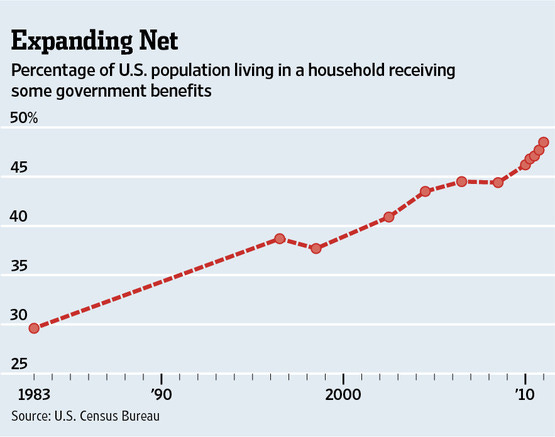
Even for younger couples, divorce puts a significant dent on their productive capacity. The family income of those who divorce is reduced by 40 to 45% if neither person remarries. Such a massive reduction in income means many of these people end up on government assistance when they would not have otherwise. This may partially explain the significant increase of those on welfare over the past few decades.
It’s probably not a coincidence that the state with the lowest divorce rate, Utah, is also ranked #1 in fiscal sustainability. This freeing up of public resources may also be part of why Utah ranks #3 in infrastructure quality and #4 in education quality.
As White Identitarians, we should keep in mind that reducing premarital sex would also reduce miscegenation. About 14% of births from White women (where the father’s race is known) are from a non-White father.


The “unknown” category is probably somewhat more non-White, so we could say maybe 15% of total births from White women are non-White. This is in contrast to marriages, where only 12% of White women are marrying someone of another race.


In other words, the miscegenation rate for out of wedlock births is decently higher than within wedlock, probably 30 or 40% higher.
This also doesn’t factor in how many Whites decided to marry-out because promiscuity crippled their romantic decision making capacity. Without premarital sex, it’s conceivable that the miscegenation rate could be driven below 10%.
Moving Forward
If you’ve read to this point, it should be clear that premarital sex is a public health catastrophe, one that is measurable in dollars and immeasurable in the broken hearts of couples and the damaged upbringings of children.
Whether intentionally or not, Damien Chazelle and Richard Linklater captured the tragedy of our times artistically. They illustrated how even fairy-tale romances are capable of collapse and possibly weaker even than arranged marriages that at least had a firm foundation.
We should not live in a world where arranged marriages have a better chance of success than soulmates. We should not live in a world where Mia and Sebastian are forever severed from each other and Jesse and Celine are on the ropes. It doesn’t have to be this way. This is a policy choice, emanating from toxic cultural institutions and an occupation regime that is indifferent to our national well-being.
When Mia and Sebastian sit down to watch the reel of what their life could have been, they sit in the place of all the men and women of our civilization. I imagine there is a grainy fantasy living in the minds of so many of our people as they lay in the cold husk of their reality. This will be our world as long as we continue to enable our regime to immiserate us through fanning the flames of vice. If you think that families can survive under this arrangement, then you’re living in la la land.

Methodology:
Nonspousal data for women, starting in 1905 and ending in 2015:
3.5 5.5 7 8 12.5 15.5 18.5 31 36 47 60 67 73
For 1975 onward, used Chart 6 data all 2+ partners. For 1970 and prior, divided numbers in chart 5 by two.
Unmarried at 40 numbers:
12.5 11.5 11.5 8 6 5 6 7.5 10 14 19 23 29 35
Male nonspousal numbers and estimates:
27 30 33 37 43 45 55 78 85 90 90 90 90
Formula for 1970 and prior:
(female nonspousal+(unmarried at 40+(100-unmarried at 40)*(male nonspousal/100)))/2
Formula for 1975 and later:
=((unmarried at 40+(100-unmarried at 40)*(female nonspousal/100))+((unmarried at 40+(100-unmarried at 40)*(male nonspousal/100)))/2
Used female unmarried rates for male as well since little significant difference at 45.
This is a very interesting analysis. It’s almost unthinkable that some of the solutions you propose could be imposed or passed into law in a society as culturally and religiously diverse as ours, but I think many of them would work. Some might say this is “radical” thinking, but we live in an era of soul-destroying and hellish conformity, which in itself is a radical departure from historical norms, so I like your out-of-the-box thinking.